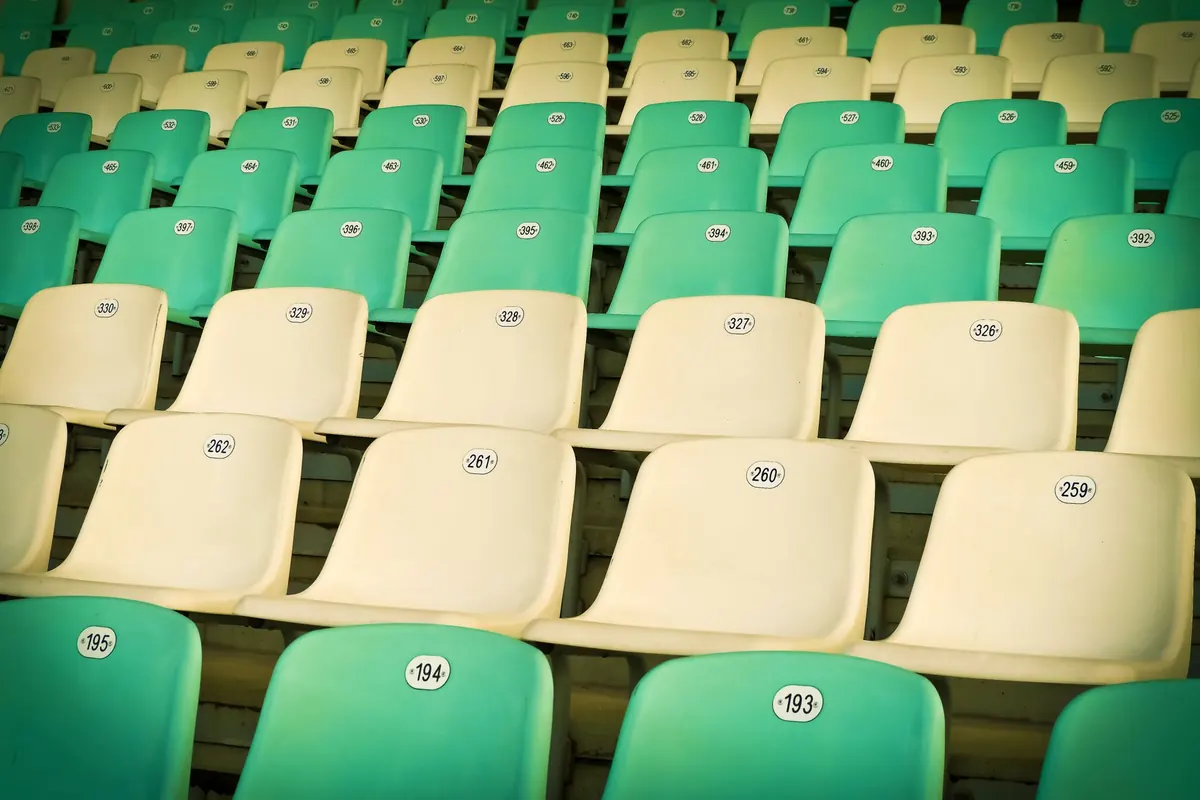
Stadium Seat Comfort Explained: Backrests, Widths, and Legroom
A stadium seat makes its case in the first minute. You sit down, and three things happen almost at once: your hips find the edges of the seat, your shoulders find the backrest, and your knees find the row in front. If all three land comfortably, you will probably forget about the seat for the next two hours. If one of them misses, you will think about it every time the play stops.
Comfort in a stand is rarely about plushness or clever design. It is mostly geometry — width, back, and space — plus a handful of small decisions made by the people who built the ground years before you bought the ticket. Once you know what to look at, you can read a seating plan almost the way a regular reads a fixture list.
The three measurements that decide everything
Every seat in every stadium is defined by a small set of numbers. Three of them do most of the work.
Seat width is the distance from one side of your allocated space to the other, measured either between armrests or between the invisible dividing lines on a bench. Backrest height and angle describe how much of your back is supported and how far the seat leans. Row spacing, sometimes called tread depth, is the distance from the back of one row to the back of the row in front; legroom is roughly that figure minus the depth of the seat itself.
None of these numbers usually appear on a ticket. But they explain almost every complaint you hear on a concourse: too narrow, too upright, nowhere to put my knees. If you can find a stadium's seating specifications, or a photo taken from a seat in the block you are considering, you can usually estimate all three.
Seat width: where four centimetres becomes a mood
Width is the most personal of the measurements, because it is the one you share with strangers. Older grounds, and older stands within modern grounds, often sit in the range of roughly 45 to 48 centimetres per seat. Newer builds tend towards 50 to 55, with premium and hospitality areas going wider still. Those few centimetres sound trivial on paper. Across a ninety-minute match, with a coat on in winter, they are the difference between sitting still and sitting defensively.
Width is also not only about body size. It is about what you bring with you. A bag at your feet, a jacket over the armrest, a child half on your lap — all of it eats into the same space.
Look at what kind of seat you are buying:
- Individual bucket seats with their own armrests give the clearest boundaries, though shared armrests can still be a negotiation.
- Bench or rail seating allocates a painted width rather than a physical one, so in practice you get as much room as your neighbours allow.
- Folding tip-up seats are common in modern stands; they usually add a little legroom when the row in front stands up, but the mechanism can make the seat feel firmer.
- Terracing offers no seat at all, only a rail and a step, which some spectators prefer and others find exhausting.
If you are tall or broad-shouldered, aim for an aisle seat or a block built after the ground's last redevelopment. Both tend to be more generous. Ask the ticket office directly — most are willing to say whether a block has older seating.
Backrests: height, angle, and what support actually means
A backrest does two jobs. It holds you upright so your spine is not doing all the work, and it gives you something to lean into when the game gets tense. A seat can fail at either.
Where the backrest ends matters more than how tall it looks
The important question is not the total height of the shell but where the top edge meets your body. A backrest that stops around mid-back leaves the shoulders unsupported; you slump forward within twenty minutes and start compensating with your neck. A backrest that reaches the shoulder blades, with a slight curve at the top, is far kinder over a long afternoon. On older plastic shells, the top edge is often a hard rim — sit forward slightly and you will feel it.
Angle: the railway problem
Many stadium seats are set close to vertical, partly for sightlines and partly for space. That is fine for a two-hour match and miserable for anything longer, because an upright seat pushes the work of balance onto your hips and lower back. A small recline — enough to feel, not enough to change your view — transforms the experience. Test it before you commit to a season ticket: sit in the seat, lean back deliberately, and see whether your head ends up in a position you could hold for the whole game.
Material, drainage, and the details
Moulded plastic shells with drainage slots are standard outdoors, and for good reason: they dry quickly and survive weather. The trade-off is that thin padding wears away. If the seat looks like a plain hard shell, plan accordingly — a folded jacket does more for your comfort than most upgrades.
Legroom and row spacing: the hidden variable
Legroom is the measurement spectators complain about most and understand least. It is not one number but the result of several: how far apart the rows are, how deep the seat is, how steeply the stand rises, and whether anything has been bolted in the way.
When a stand is built steeply, the same row spacing can feel more generous, because your feet drop onto the step below rather than pressing flat against a wall of plastic. When a stand is shallow, the row in front sits closer to eye level and to knee level both.
Watch for the things that quietly steal legroom:
- Railing posts and glass balustrades at the front of a block or on a gangway edge
- Access steps that cut into the end of a row
- Wheelchair platforms and companion spaces, which take up floor area
- Camber in older stands, where the floor slopes and one side of the row is tighter
- Camera positions or gantries that force seats to be squeezed
A practical rule: if you can sit with your knees at roughly ninety degrees and still have a hand's width between your knees and the seat in front, you have enough. If your knees touch the shell, you will spend the match turning sideways, and the person behind you will inherit the problem.
The comforts you notice only after forty-five minutes
Some factors never show up in a photograph and only reveal themselves over time. The height of your row relative to the one in front decides whether you watch the match through a gap or around a head. Shelter from wind matters more than temperature: a covered stand can feel warmer than a sunlit open one. Aisles trade legroom for the freedom to stand up without disturbing four people. And the small pleasure of a seat that faces the pitch squarely, rather than at an angle across a curve, is worth more than it sounds.
If you have back or knee trouble, treat these details as part of choosing a ticket rather than an afterthought, and speak to the club about accessible or aisle seating. Persistent pain is worth raising with a healthcare professional rather than solving with a cushion.
How to choose a comfortable seat before you buy
- Find the block's build date. Post-redevelopment stands are usually wider and better spaced.
- Look for a photograph taken from the seat itself. It will show knee clearance and backrest height honestly.
- Ask the ticket office three questions: seat width, whether seats have individual armrests, and whether the row is behind a railing.
- Prefer an aisle if you are tall, broad, or likely to need the toilet at half time.
- Check the rake. A steep stand gives better sightlines and, usually, more usable legroom.
- For a season ticket, sit in the actual seat before signing — even a single match will tell you more than any plan.
Comfort is not a luxury feature bolted onto a stadium. It comes from three plain measurements and a few sensible choices, and once you know how to read them you will pick better seats for the rest of your supporting life.
Photo: Pexels / Pixabay
You Might Also Like
Stadium seating safety is decided in the geometry — continuous handrails, honest aisle widths and evacuation routes that work long before the seats are chosen.
Sensors and connected ticketing turn stadium seats into sources of useful information about usage, queues and crowd movement — if the basics are right.